BrokerTH
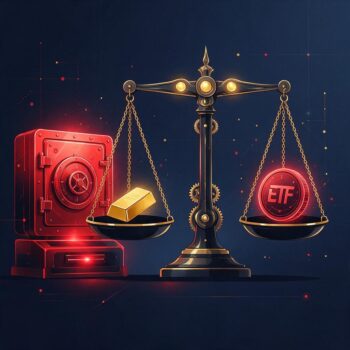
A Thai retail investor with ฿100,000 to allocate faces genuinely different options than two years ago. Fixed deposits at Thai banks. Physical gold or gold savings accounts. And now, regulated crypto ETFs covering Bitcoin, Ethereum, and recently Solana. Each has a current data point worth examining: bank rates around 1.5–2.2%, gold at ฿72,084 per baht weight, and BTC at $79,697 after a week that included a 4% drop and recovery. Here’s what each actually delivers—without the usual “diversification is good” filler.
Fixed Deposits: The Boring Option That Makes Sense for Some
Thai commercial bank fixed deposit rates in September 2026 range from roughly 1.5% to 2.2% per annum, depending on term and institution. SCB, Kasikorn, and Bangkok Bank generally sit in the same band. On ฿100,000 at 1.8% for one year, you earn ฿1,800—subject to 15% withholding tax for Thai residents, leaving ฿1,530 net.
That’s not exciting, but it’s not supposed to be. Fixed deposits offer capital guarantee (deposit protection up to ฿1 million through the DPA), zero volatility, and predictable returns. In an environment of genuine global uncertainty—Iran tensions, Fed uncertainty, oil price risk—the guaranteed ฿1,530 net beats the potential of losing ฿10,000–฿20,000 in a crypto or gold drawdown if you can’t absorb that loss.
The honest limitation: at 1.8%, you’re likely running behind Thai inflation, which has been running at 2–3%. Your real return is negative. Fixed deposits preserve nominal capital; they erode real purchasing power over time. That’s the trade-off, stated plainly.
Gold: Familiar, but Not Cheap Right Now
Gold’s appeal in Thailand is partly cultural and partly financial. At ฿72,084 per baht weight, gold has delivered long-term returns that beat inflation over most five-year and ten-year periods in Thai baht terms. One baht weight costs ฿72,084, so ฿100,000 buys roughly 1.39 baht weights. Transaction costs at a gold dealer—the spread between buy and sell price—typically run ฿200–฿400 per baht weight each way, adding roughly 0.3–0.6% to your entry and exit cost.
Gold savings accounts at Thai banks (SCB Gold Savings, Bangkok Bank Gold Savings) allow fractional accumulation and eliminate storage concerns. Worth using if you want steady gold exposure through monthly purchases rather than a lump-sum position.
The current risk: gold is near the top of its recent range, and the September 16 FOMC introduces two-way risk. A Fed hold that weakens the dollar could push gold toward ฿74,000–75,000. A hawkish surprise could knock it back toward ฿69,000–70,000. You’re buying at an inconvenient moment in the cycle.
Crypto ETF: The High-Variance Option
A ฿100,000 investment in a Thai BTC ETF gives you Bitcoin exposure without custody and exchange risks. At $79,697 per BTC and USD/THB at 32.93, you’d own the equivalent of roughly 0.038 BTC—a fractional position that trades daily based on BTC price and the baht exchange rate simultaneously.
The recent week illustrated the risk concisely: a 4% drop in two days on Iran news, followed by a 4% recovery. On ฿100,000, that’s a ฿4,000 swing down and back. Crypto ETF investors who cannot emotionally tolerate that movement—and who might sell at the bottom—should not be in this asset class at all. The ETF wrapper makes it easier to access; it doesn’t make the underlying asset less volatile.
For investors with a three-to-five-year horizon who can ignore short-term noise, BTC exposure through a Thai ETF is a legitimate portfolio component. Most frameworks suggest 5–10% of a portfolio in crypto. On ฿100,000, that’s ฿5,000–฿10,000, not the full position.
What the Comparison Actually Tells You
Each asset serves a different purpose, and combining them isn’t just about “diversification”—it’s about matching each allocation to a specific financial goal:
- Fixed deposit (฿70,000): Capital base, guaranteed, accessible. Accepts negative real return in exchange for certainty.
- Gold savings account (฿20,000): Monthly accumulation, inflation hedge, zero storage risk.
- BTC ETF (฿10,000): High-risk growth option. Sized so a 50% drawdown in crypto costs you ฿5,000, not ฿50,000.
Adjust the ratios based on your investment horizon and ability to absorb losses. The point isn’t that this specific allocation is optimal—it’s that treating all three as interchangeable is how investors make bad decisions under uncertainty.
The One Thing All Three Share
None of them provide a guaranteed real return right now. Fixed deposits are behind inflation. Gold is near its recent range ceiling. Crypto just recovered from a geopolitical scare that knocked it 4% in two days. The choice isn’t about which asset will perform best—it’s about which risk you’re most comfortable holding, and for how long.